Get started with GeneExprLupusMx
What the package contains and where to start
2026-10-31
Source:vignettes/intro_en.Rmd
intro_en.RmdWhat is GeneExprLupusMx?
GeneExprLupusMx is an R package with
transcriptomic (RNA-seq) data from Mexican women with systemic
lupus erythematosus (SLE) and from healthy controls. It is
designed for research and teaching: besides the data, it includes
step-by-step lessons to learn how to analyze them.
-
33 participants: 10 healthy controls
(
Ctrl) and 23 patients with lupus (SLE). - 3 cell types per participant: monocytes, monocyte-derived dendritic cells (moDC), and tolerogenic dendritic cells (tolDC).
- 99 samples in total (33 × 3).
The data come from the article:
Hernández-Ledesma AL, Coss-Navarrete EL, et al (2026) Gene expression profiling of dendritic cell tolerance dysfunction in women with systemic lupus erythematosus. Front. Immunol. 17:1771959. doi: 10.3389/fimmu.2026.1771959.
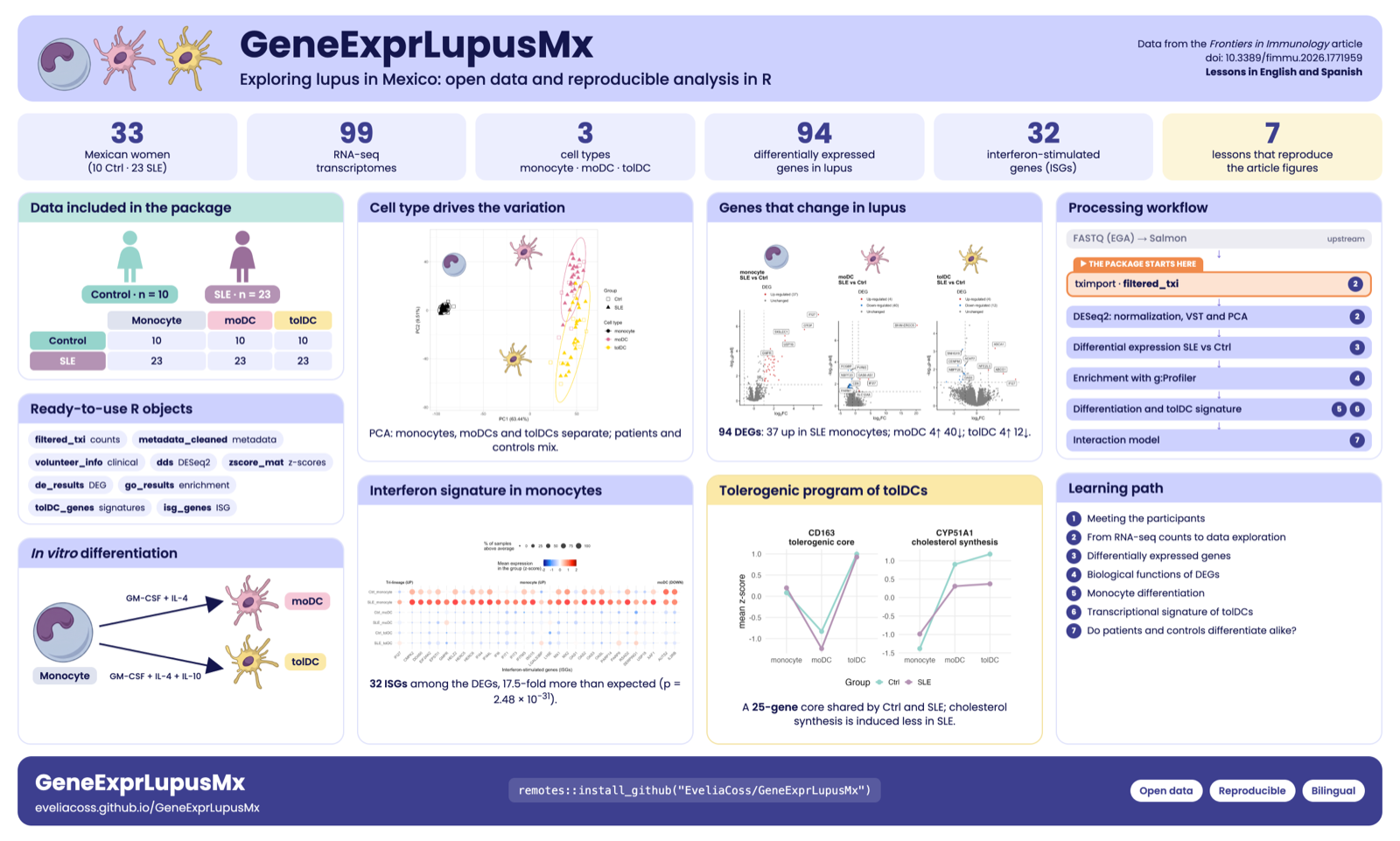
Overview of the study and of the package contents.
Installation
Install the package from GitHub. Some
lessons also use DESeq2, available on Bioconductor:
install.packages(c("remotes", "BiocManager", "tidyverse"))
remotes::install_github("EveliaCoss/GeneExprLupusMx", build_vignettes = TRUE)
BiocManager::install("DESeq2")
Once installed, load it:
What data does it contain?
The package includes three main datasets.
metadata_cleaned and volunteer_info are
available as soon as you load the package. filtered_txi is
larger, so it is not installed with the package: it is downloaded with
download_data() the first time you use it, and then read
from your computer.
| Object | What it contains | One row per | Size |
|---|---|---|---|
filtered_txi |
RNA-seq counts quantified with Salmon and imported with
tximport
|
gene | 21,718 genes × 99 samples |
metadata_cleaned |
Group, cell type, and clinical data for each sample | sample | 99 samples |
volunteer_info |
Age, diagnosis, treatments, and recruitment date | volunteer | 33 volunteers |
It also includes reference gene lists used by some lessons:
| Object | What it contains | Used in |
|---|---|---|
biotype_summary |
Biotype of each gene (protein-coding, lncRNA…) | Lesson 4 |
sle_genes |
Genes associated with lupus in the literature | Lesson 4 |
isg_genes |
Interferon-stimulated genes (Yu et al., 2025) | Lesson 4 |
moDC_genes |
Genes described in the differentiation from monocyte to moDC | Lesson 5 |
dc_genes |
Genes associated with dendritic cell differentiation | Lesson 5 |
tolDC_genes |
Transcriptional signature of tolerogenic dendritic cells (Robertson et al., 2021) | Lesson 6 |
It also includes checkpoints: objects that are built
in one lesson and saved in the package so that the next lesson can start
from there, without repeating the steps. The two largest,
dds and zscore_mat, are also downloaded with
download_data().
| Object | What it contains | Built in |
|---|---|---|
dds |
Filtered and normalized DESeqDataSet (13,596 genes × 99
samples); requires DESeq2
|
Lesson 2 |
zscore_mat |
Matrix of z-scores of VST expression, for heatmaps (13,596 genes × 99 samples) | Lesson 2 |
de_results |
SLE vs Ctrl differential expression results for each cell type
(DESeq2) |
Lesson 3 |
go_results |
Enriched functional terms of the DEGs (g:Profiler, version e113) | Lesson 4 |
de_celltype_results |
Differential expression of moDC and tolDC against monocytes, in
controls and patients (DESeq2) |
Lesson 5 |
go_celltype_results |
Enriched functional terms of those DEGs (g:Profiler) | Lesson 5 |
de_interaction_results |
Group:Cell_type interaction: genes whose change from
monocyte to dendritic cell is different in patients
(DESeq2) |
Lesson 7 |
go_interaction_results |
Enriched functional terms of those genes (g:Profiler) | Lesson 7 |
A quick look at each one:
filtered_txi <- download_data("filtered_txi") # only downloads the first time
dim(filtered_txi$counts)                        # genes x samples
#> [1] 21718    99
head(metadata_cleaned[, c("sample_ID", "Group", "Cell_type")], 3)
#>         sample_ID Group Cell_type
#> QR011_0   QR011_0  Ctrl  monocyte
#> QR011_1   QR011_1  Ctrl      moDC
#> QR011_3   QR011_3  Ctrl     tolDC
head(volunteer_info[, c("Volunteer_ID", "Group", "Age_years", "Time_of_recruitment")], 3)
#>   Volunteer_ID Group Age_years Time_of_recruitment
#> 1        QR011  Ctrl        25          2022-06-01
#> 2        QR013  Ctrl        23          2022-06-01
#> 3        QR014   SLE        32          2022-06-01
How are they related?
The three tables are connected through their identifiers. Each sample
has a name such as QR011_1: the first part
(QR011) identifies the volunteer and the final number
identifies the cell type (_0 = monocyte, _1 =
moDC, _3 = tolDC).
flowchart LR
  T["filtered_txi
counts per gene"] -- "columns = sample_ID" --- M["metadata_cleaned
one row per sample"]
  M -- "Volunteer_ID
(prefix of sample_ID)" --- V["volunteer_info
one row per volunteer"]
# The count columns are in the same order as the metadata rows
all(colnames(filtered_txi$counts) == metadata_cleaned$sample_ID)
#> [1] TRUE
# From sample to volunteer
sub("_.*", "", "QR011_1")
#> [1] "QR011"
To learn about each column in detail, see the help pages:
?filtered_txi, ?metadata_cleaned, and
?volunteer_info.
Learning path
The lessons are designed to be followed in order, but each one can be read on its own.
| Lesson | You will learn to… | Data | Time |
|---|---|---|---|
| 1. Meeting the participants | Describe the cohort with descriptive statistics, tables, normality tests, and comparisons between groups | volunteer_info |
45 to 60 min |
| 2. From RNA-seq counts to data exploration | Import the counts, normalize them with DESeq2, explore
genes, and make heatmaps and PCA |
filtered_txi, metadata_cleaned,
volunteer_info
|
1 to 1.5 h |
| 3. Differentially expressed genes between patients and controls | Validate cell types with biomarkers, run differential expression
with DESeq2, and interpret volcano plots |
filtered_txi, metadata_cleaned,
zscore_mat
|
1.5 h |
| 4. Biological functions of differentially expressed genes | Run a functional enrichment analysis with g:Profiler, identify SLE and ISG genes, test their enrichment (hypergeometric and Fisher), and correlate ISGs with disease activity |
de_results, go_results,
sle_genes, isg_genes,
biotype_summary, zscore_mat,
metadata_cleaned, volunteer_info
|
1.5 h |
| 5. Differentiation of monocytes into dendritic cells | Compare dendritic cells against monocytes, validate differentiation with known genes, and explore pathways and lipid metabolism |
de_celltype_results, go_celltype_results,
moDC_genes, dc_genes
|
1.5 h |
| 6. The transcriptional signature of tolerogenic dendritic cells | Evaluate tolDC with a published signature, combine z-scores and LFC, choose the right reference for comparison, and identify the genes that agree with the signature |
tolDC_genes, de_celltype_results,
zscore_mat
|
1 h |
| 7. Do patient and control cells differentiate in the same way? | Fit a model with an interaction, interpret a “difference of differences”, summarize the genes with Reactome processes, and plot expression trajectories |
de_interaction_results,
go_interaction_results, zscore_mat,
isg_genes
|
1.5 h |
Each lesson includes challenges with their solutions for practice, and ends by reproducing a figure or table from the article.
In addition, the guide How
to use the package functions shows how to apply
get_heatmap_mat(), create_heatmap(),
process_go() and reduce_go_terms() to your own
data.
How to cite
There are two citations: one for the package and one for the data. If you use this resource, please include both.
1) How to cite the package (lessons, functions and R objects):
Coss E (2026) GeneExprLupusMx: Transcriptomic data of lupus in Mexican women with learning lessons. R package. https://github.com/EveliaCoss/GeneExprLupusMx doi: 10.5281/zenodo.23751369.
This DOI always points to the latest version; on Zenodo you can find the DOI of each version.
2) How to cite the data (original article and analysis in Zenodo):
Hernández-Ledesma AL, Coss-Navarrete EL, et al (2026) Gene expression profiling of dendritic cell tolerance dysfunction in women with systemic lupus erythematosus. Front. Immunol. 17:1771959. doi: 10.3389/fimmu.2026.1771959.
↑ Back to topCoss-Navarrete EL, Hernández-Ledesma AL, et al (2025) Analysis of gene expression profiles during tolerance induction in dendritic cells from women with Systemic Lupus Erythematosus [Data set]. Zenodo. doi: 10.5281/zenodo.17742206.